

When will my reflection show... 🎵
Three simple questions can improve your quality of life
First: pleasantries
G’day campers! I write to you from a rather crisp, fresh morning. Bunuru1 has given way to Djeran, bringing cool mornings and, for me, an urge to contemplate.
I’ve been reflecting on reflecting, exactly the sort of metacognitive funambulism my brain likes to perform without asking.2

Context
I’ve been engaged in casual university teaching as my side hustle pretty much since I arrived in Perth. It began with working as a tutor3 (American readers, please see that footnote for a quick explanation of the Aussie uni system, because this word means something different Down Under), progressed into a bit of lecturing, and I decided to take this semester off after my health issues at the end of last year. However, the opportunity came up for some casual relief marking, and I was grateful to dip my toe back in.
An overview of the process
On a basic level, we ask our students to follow the “What/So What/Now What” model.4 In summary, this is what it looks like:
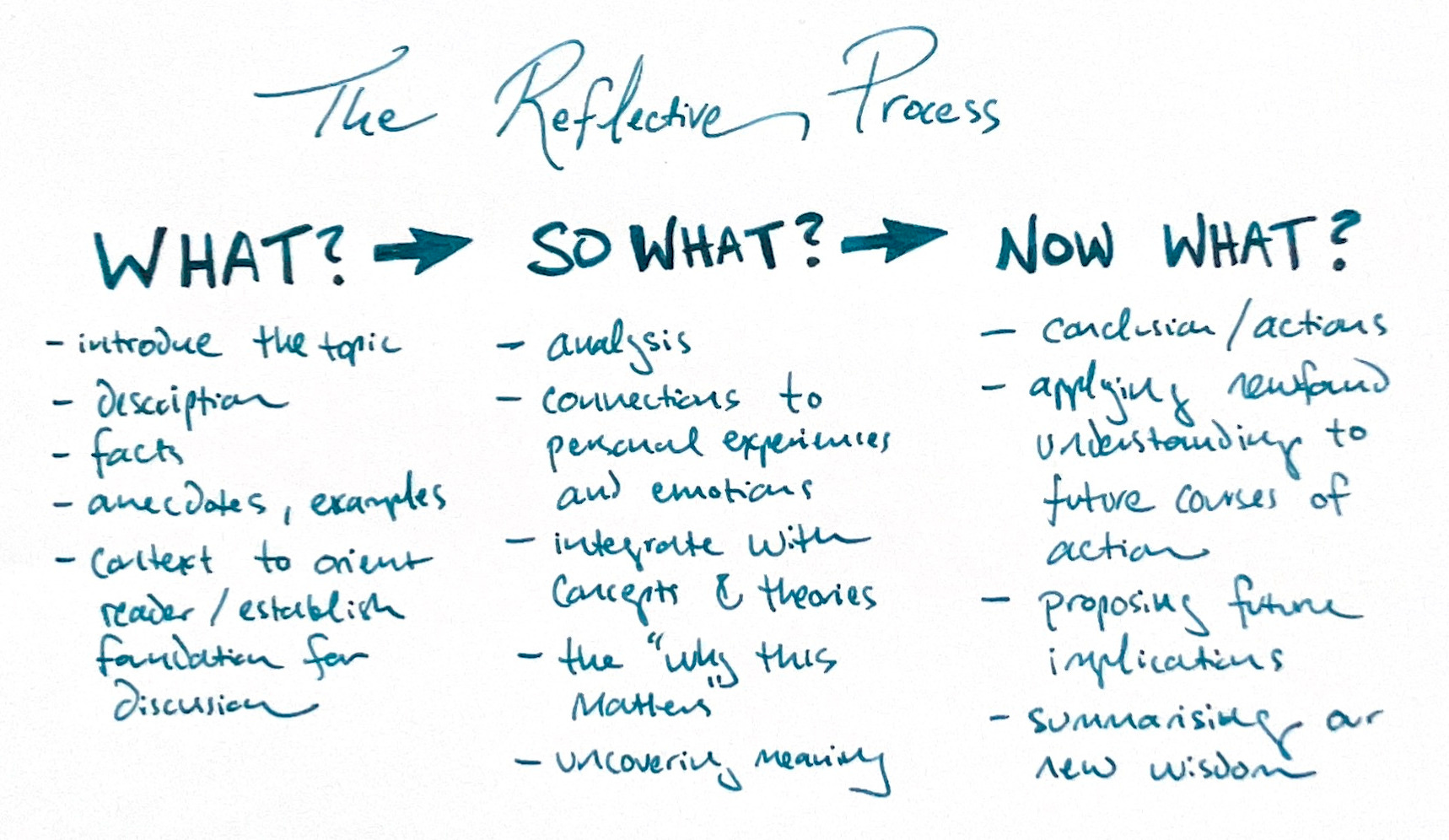
Execution of the process
It’s fairly straightforward as a concept, but first-timers can be remarkably bad at it. Immature reflections skim the surface and the content is largely description. They’ll write multiple sentences describing a situation or how they felt, then jump into a list of solutions, which are hasty band-aids rather than meaningful actions. These are novice mistakes and part of the learning process when developing this skill.
A good reflection uncovers new ground with every sentence, links concepts or theories, discusses emotions or concerns in wider context, and makes connections to other areas of life or learning. It’s a lot to pack into 400 words.
Generative AI/LLMs aren’t good at reflective writing5, but that doesn’t mean students don’t try, which is a shame. Teachers don’t assign reflections because we want to read them. The learning the process of reflection is inherently useful and helps students arrive at newfound understanding; we’re trying to help them develop a skill.
I like to emphasise that the reflective process will help every aspect of their lives: study, personal goals, hobbies, family relationships, even their love life (that always gets a few giggles). It’s well worth the investment, like learning to drive a car or make good homecooked meals.
The “reason” is often not the reason
Many students, when discussing (for example) their relationship with study or procrastination, sum up their problem: I procrastinate because I’m lazy; I lack motivation; I have ADHD/autism/dyslexia/depression/anxiety (more on this later).
This “epiphany” then gives way to a list of solutions: I will try harder; I will try to use my phone less; I will remind myself study is important and I need to make my family proud; I will overcome my brain’s neurospiciness/mental health issues.
None of this is wrong or bad, but part of my job is helping students see that this the beginning of the story, not the end. Latching onto a diagnosis or labelling a perceived flaw and declaring “I shall do better” isn’t helpful, and it’s unlikely to lead to long-term success or change.6
A personal example
Let’s take the label of “lazy”. I’ll apply it to my own life on the topic of Before-Bed Self-Loathing, but in an abbreviated dot-point format.
What?
UGH!! It’s almost 10pm and I’ve accomplished nothing. All I’ve done after work is eat dinner, mooch around on my phone, and suddenly it’s time for bed. I’m so lazy and pathetic. [ insert more self-berating ]
So What?
Wait, is this actually laziness? I genuinely want to do things, but it’s hard to get motivated. Let’s remove the label: I struggle to achieve my goals and then berate myself about it at bedtime.
Why? Let’s analyse the facts:
I’m tired from working all day (fact). But is my job physically taxing? (office job, so no). Therefore, when I’m healthy (which varies), I should have plenty of energy for an enjoyable and productive arvo.
I lose track of time and all of a sudden it’s almost 10pm (fair enough). But what am I doing in this time? Drive home, change into sweats, flop on sofa, doomscroll, don’t get up until it’s time to make dinner, watch TV during dinner, binge more episodes until it’s time for bed, and then I have a little meltdown.
Bad habits create and enforce this cycle, because I struggle to sleep, and then the next day I wake up cranky.
I’ve been under an immense amount of stress over the past few months—my capacity is low and my mental health is pretty poor. Berating myself is resulting in shame, distress, and shutdown. I must change tactics in how I talk to myself.
Why do I engage in these bad habits instead of working on my goals?
Goal examination: do I really want these things? (yes) Have I sufficiently broken down goals into smaller steps to allow me to achieve success on a Tuesday afternoon? (umm…no)
Basically I’m daunted by the herculean task of, say, writing a novel or cleaning the entire house perfectly, after doing a full day of work.
The problem: I’m setting myself up to fail the moment I get home. My goals are not realistic or achievable, therefore I’m using my phone as a pacifier until I make dinner, and then switch to TV to do the same thing, and suddenly it’s time for bed. I’m purposefully-yet-unintentionally wasting time to distract myself from doing something that’s hard.
Now what?
I’ll try taking a short walk to get fresh air and my blood pumping. An energising break will set the tone for my evening.
I’ll save TV for Friday and weekend nights; during the week, we’ll eat dinner at the table and choose an alternate post-dinner activity, such as tackling a chore, reading, writing for 30-60 min, etc.
I’ll examine my goals and break them down into tangible, manageable pieces. For example, rather than putting “WRITE NOVEL” on my daily to-do list, I’ll use “20 minutes novel”, or itemise specific household tasks rather than “CLEAN HOUSE.”

Apologies, my Millennial is showing. All credit to Hyperbole and a Half by Allie Brosh. On days when I’m physically not well, I will give myself permission to engage in meaningful rest and do that instead of doomscrolling aka purgatory.
I’ll practice self-compassion when I slip up. Tomorrow is a new day. I’ll congratulate myself on small wins.

Note: addressing conditions which make life a little more challenging
What if your barriers stem from ADHD, autism, dyslexia, depression, anxiety, chronic illness, or [insert-your-own-adventure-here]? These conditions present difficulties around executive function, concentration, and information processing, and can cause nervous system overwhelm, pain, exhaustion, and accessibility challenges. I’m not discounting or dismissing this.
But using a diagnosis as the root cause during the reflective process is unhelpful and inaccurate. The reflective process can help us identify our strengths, weaknesses, and what we need to perform at our best. A diagnosis isn’t the end of the conversation; it’s the beginning. It should be used as tool to help you understand yourself better and find your own “cheat codes”.
I’m a chronic overthinker with perfectionist issues and I’ve had anxious tendencies since I could spell my own name. (Additionally, over the past few months, I’ve been battling an invisible and fluctuating health condition.) From the outside, I think I give the appearance of having my shit together. People seem surprised when I say I struggle with procrastination and self-doubt. But doomscrolling on the sofa is a direct result of this; if I can’t do it a perfectly, why bother? If the world is going to hell in a handbasket and GenAI will render authors obsolete, why write? If I can’t do all the tasks, I might as well give up and do none.
The reflective process showed me how to fight back against defeatist self-talk and shutting down. The result? Small changes become habit, good habits enable progress, progress encourages, and I’m happier, healthier, and more motivated.
The Result
I didn’t make up this example; several weeks ago, I genuinely had to sit down and think about this. I discovered my root cause of my Before-Bed Self-Loathing wasn’t my health condition or anxious tendencies. It was two behavioural actions: (1) immediately crashing on the sofa after work, which set a poor tone for the evening, and (2) watching TV during dinner, which made it easy to lose track of time. This realisation was pretty empowering.
Since implementing my actions, I’ve finished edits of Quiver, sent it out to 5 agents, written several Substack articles, and read a few books. My husband has also achieved a number of creative goals and is playing more music. Our house is tidier. We’re eating better. We are calmer and more energised.
(But everything in moderation: we allow “cheat days” to grab takeaway and watch Taskmaster or QI when we’ve had a rough one. But these are giddy, gleeful evenings now, like we’re cheeky kids engaging in some low-level mischief against the adults.)
Why reflection is a valuable skill
The “What/So What/Now What” model is a useful framework, but reflection comes in many intuitive forms. Journalling, having a meaningful conversation with someone we trust, thinking by talking out loud to ourselves when we’re alone, or the gentle, detached thinking we do when we’re engaged in something else and can’t reach for our phone (driving, walking, taking a shower) also qualify as reflective thinking.
Reflection is when we connect ideas or experiences from different areas of our lives. This process informs and enriches our understanding of ourselves, others, and the world around us.
If we don’t reflect, how can we know what we truly think?
If we don’t know what we think, how do we know what we want?
If we don’t know what we want, how can we make meaningful goals?
If we don’t make meaningful goals, how can we achieve?
If we don’t achieve, how do we feel a sense of purpose and fulfillment?
If we don’t know what gives us a sense of purpose and fulfillment, how can we know ourselves at all?
My challenge to you
Give it a whirl. Using either the “What/So What/Now What” model or more intuitive free writing, choose a challenge in your life and try to examine it from all angles. See if you can reach any newfound understanding. Even if the solution is to acknowledge you’re dealing with a particularly tricky time (parents of small children and carers, I see you) and your action is “give myself grace and practice self-compassion”, that’s a win.
Finally, a quick poll
There is an option for me to record audio and include this at the top of my Substack articles. I’d record this myself in my own voice, reading the article aloud, sorta like a mini podcast. I’m curious if my readers would enjoy this, so please answer below:
Bunuru is our second summer and also known as the Season of Adolescence according to the Indigenous Noongar calendar; Djeran is associated with cooler weather and also known as the Season of Adulthood. Link here: https://australiassouthwest.com/six-seasons-of-the-south-west/
It’s often entertaining and useful, but the dark side is overthinking, rumination, and winding myself up over scenarios which haven’t happened, are unlikely to happen, and regardless, the frantic hamster-on-a-wheel preparation I’m attempting wouldn’t help anyway. Yay, thanks, weird brain!
The general structure for undergrad classes, at least the classroom-based humanities units I teach, is one weekly lecture-workshop of two hours, which can contain a few hundred students across the unit, accompanied by a weekly tutorial. The tutorial classes are an hour long and broken into groups of no more than 20. The tutorials are lead by a tutor teacher and designed to be interactive to apply the content covered in the lectures. Tutors also mark student assessments (essays etc.) and determine their grades, supporting the unit coordinator/lecturer.
In Australia, the word “tutor” is also used when referring to external additional teaching sessions outside the usual daytime K-12 schooling, which adds another layer of confusion. So if you’re in the UK or Australia and someone says “tutor”, figure out the context (K-12 or uni), and you’ll be set.
Source: https://reflection.ed.ac.uk/reflectors-toolkit/reflecting-on-experience/what-so-what-now-what
This article’s focus isn’t LLMs, so I didn’t want to include this in the body, but here’s some extra info if you’re interested. In the three and a half years I’ve been teaching, there’s been a big shift: when I started, Generative AI/LLMs weren’t really a thing. Students were warned about poor paraphrasing, self-plagiarism, contract cheating, and collusion, but “an advanced predictive text program which spits out the entire assignment after I copied and pasted the prompt” wasn’t on the menu.
I’m a casual teacher, so I dip in and out of the university world on a semester basis and I’m not part of the ongoing narrative or meetings the same way contracted staff are, but it’s felt like a game of whack-a-mole. Except the moles are armed and keep digging new holes, and our mallet is shrinking.
At the present, ChatGPT and its ilk can churn out a decent undergrad essay. Academic writing has been made so formulaic that the aspects we prize are the aspects the machine can do well: paragraphing by sub topic, topic sentences, intro and conclusion/summary, etc.
But something it’s not very good at: reflective writing. Particularly if there’s a personal element involved, such as asking students to reflect on their own experiences about a topic and connect to classroom learning. It can churn out something that looks like a reflection, but it’s hollow. I’ve caught a number of AI-generated assessments, but the reflections are the easiest to spot because they’re grammatically perfect while saying absolutely nothing at all.
The reflections I marked this semester were handwritten in class. The standard was pleasantly high. I wonder if this is because students knew they had to practice and prepare, meaning they invested in the necessary thinking time to perform well on the day.
On an unrelated note, how’s those New Year’s Resolutions going?
Thank you for this!
I too struggle with the ‘I deserve a rest when I get home from work’ thing. I start at 6:30 (up at 5am 😭 - just as well I love my job!) and finish at 2:30. Sitting with a cup of Afternoon Tea when I get home is my reward.
But if I pick up my phone and start doomscrolling, my tea goes cold, and I lose two hours.
I’m now purposely either not looking at my phone, or just catching up with emails & such. Staying away from social media allows me to put the phone down after twenty minutes or so, and then either think about my writing, do some cross-stitch, or write here on Substack.
It’s small changes. But until you’ve thought about why you do something & then how to change that if you’re not happy, you can never break out of the cycle.
Thank you 🌻
Interesting! I’m going to try this what/ so what/ now what thing… but maybe in the morning, as I’ve just doom scrolled my way to bedtime…